
Checking Evangeline Parish Criminal History
Begin with the event and the answer you need. The official parish prosecution-file custodian is the Evangeline Parish Clerk of Court. Its website links to a Cott “Public Records Search,” but the public-facing page stops at an account login. Official material does not verify its criminal coverage, available years, document access, or price. The dependable criminal-case routes remain the clerk counter, telephone, and mail. Very recent custody belongs first with the Evangeline Parish Sheriff’s Office roster. A fingerprint-confirmed copy of your own Louisiana history belongs with State Police BCII.
Before searching, gather the full name, date of birth when lawfully available, spelling variants, approximate event date, arresting agency, and a case or booking number if known. Then follow the records in sequence:
- Search the EPSO Current and Released roster views for a recent parish booking.
- Ask the arresting agency for its incident or arrest report.
- Call the clerk at 337-363-5671 to ask whether the district attorney filed a case.
- Request the charging paper, minutes, judgment, disposition, and sentence from the clerk.
- Use Louisiana Right to Review when you need your own fingerprint-matched statewide record.
Four Evangeline Parish Record Custodians
One arrest may yield four records, each with a separate purpose. The police or sheriff report states what the agency investigated. EPSO booking data records intake, bond, and release status. The 13th Judicial District Court file shows what prosecutors actually filed and how the case ended. BCII later links fingerprinted arrest cycles with reported dispositions in the state repository. None is a full substitute for the others.
| Record | Custodian | Best use |
|---|---|---|
| Incident or arrest report | Creating police agency or EPSO | Alleged facts and investigative record |
| Booking record | Evangeline Parish Sheriff | Custody, bond, and release |
| Criminal case file | Clerk of Court | Filed charge, hearings, judgment, sentence |
| Louisiana rap sheet | State Police BCII | Identity-linked state arrest and disposition cycles |
Timing explains many conflicts. Booking charges may precede the district attorney’s decision. Filed charges can change, and a court outcome may not yet be matched to the state arrest cycle. Use the original court judgment when the outcome matters.
Louisiana Official Background Checks
Louisiana is a closed-record state. The Louisiana State Police Internet Background Check is an account-based, name-only Louisiana conviction check for agencies authorized by R.S. 15:587. It is not an open public people search, is not meant for personal-use requests, and cannot replace fingerprints when a governing law requires them. The public login asks for User Name, Password, and Agency Code. The stated check price is $31, and the portal announces a $5 technology fee per check. Confirm the total during ordering.
The official BCII overview identifies the state office that maintains criminal-history information.
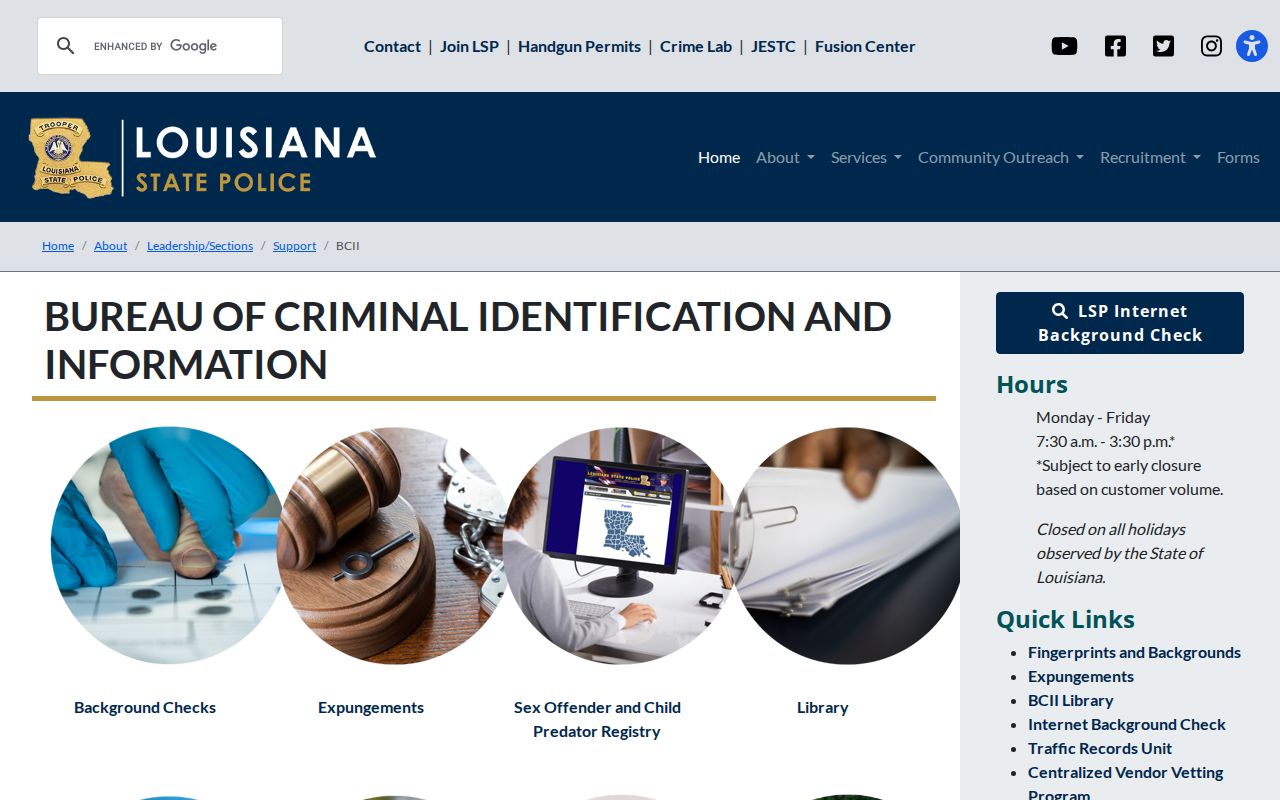
That state repository is broader than one parish file, but public access depends on the requester and legal purpose.
| Official product | Purpose | Published fee |
|---|---|---|
| Louisiana IBC | Authorized name-based Louisiana conviction check | $31 plus announced $5 technology fee |
| Right to Review by mail | Your certified Louisiana history with fingerprints | $31; $10 more for prints at LSP Headquarters |
| FBI Identity History Summary | Your FBI-maintained national identity history | $18; fingerprint capture may cost more |
Reviewing Your Louisiana Criminal Record
A Louisiana resident seeking their own authoritative state record should use the fingerprint-based Right to Review. Louisiana Applicant Processing System sites capture digital prints for BCII. Mail is also documented: send the signed authorization, two completed FBI FD-258 fingerprint cards, and the stated $31 payment by money order, cashier’s check, or business check. An attorney or representative needs the separate representative form. Because forms and charges can change, verify the current version before sending funds.
The official Right-to-Review authorization shows the fingerprint and submission route.
The certified result also gives the subject a sound starting point for checking a missing or incorrect outcome against the originating Evangeline Parish court file.
Criminal Record Types
“Criminal record” is a broad label for files made by different Evangeline Parish and Louisiana agencies. Choose the record by the fact you seek. A sheriff report covers an event investigated by EPSO. A municipal report stays with Ville Platte, Mamou, Pine Prairie, or the other agency that made it, even if EPSO later books the person. Court papers track prosecution. DPS&C records concern state prison or supervision, while the sex offender registry is a separate public-notice system.
- Arrest and booking records: agency arrest facts, jail intake, bond, custody, and release.
- Criminal court files: charging papers, minutes, motions, pleas, judgments, and sentences.
- State criminal history: fingerprint-linked arrest cycles and reported outcomes maintained by BCII.
- Warrants: agency and court data that should be verified directly before action.
- Corrections and registry records: prison, supervision, parole, and statutory registration information.
Federal prosecutions are another system. Evangeline Parish federal cases go to the Western District of Louisiana’s Lafayette Division and appear through PACER, not the parish clerk.
Evangeline Parish Jail and Custody
The EPSO inmate roster offers a name field plus Current and Released views. Its booking cards can supply a booking date, charge as understood at intake, bond, and custody status. Treat that information as a lead, not a final case outcome. A release means the person is no longer shown in current parish custody. It does not prove that charges were dismissed, filed, or resolved.
If no match appears, check spelling and both views, then call EPSO’s 24-hour non-emergency line at 337-363-2161. A new arrest may not yet display. A sentenced person may have moved to state custody. The official DPS&C imprisoned-person resources explain the state locator and automated phone route.
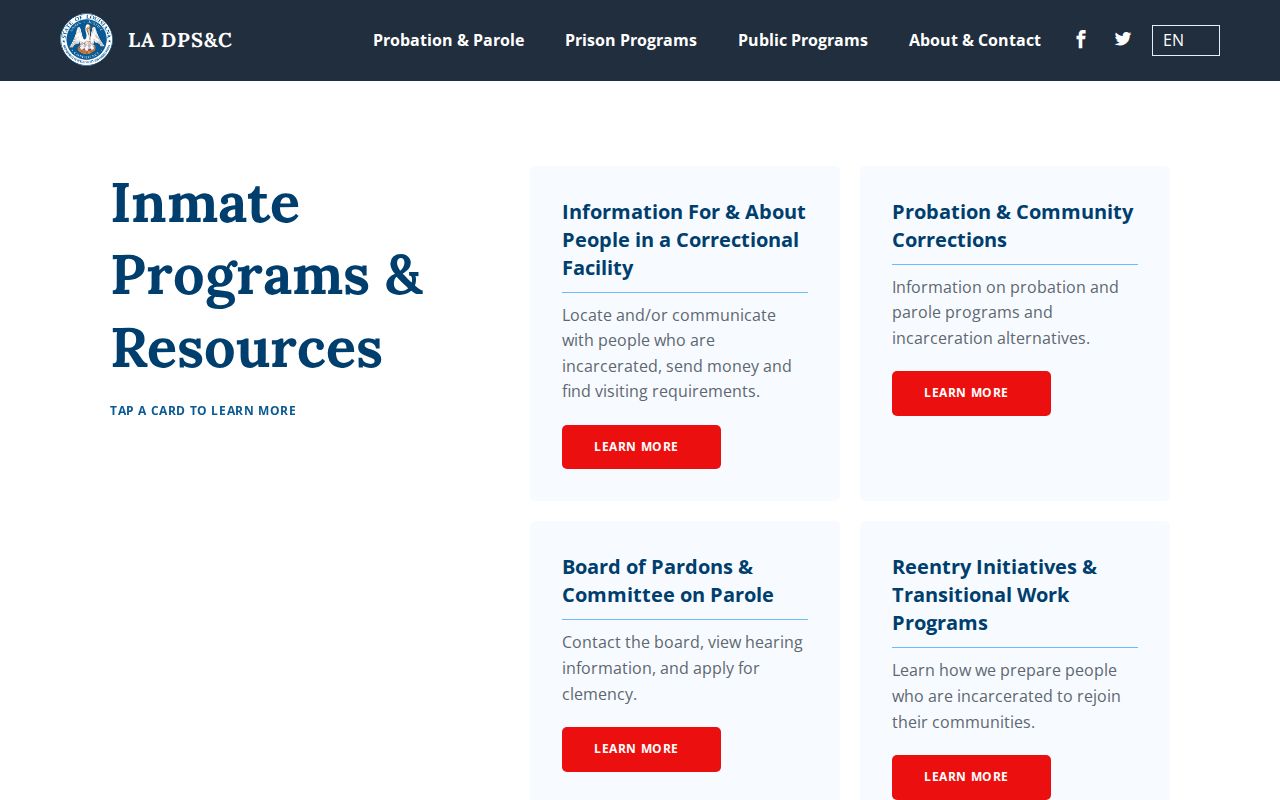
The state search requires a DPS&C number or a name and date of birth. Federal custody instead belongs in the Bureau of Prisons locator.
Inside an Evangeline Parish Criminal Record
The fields depend on the source. A BCII rap sheet organizes identity-linked arrest cycles, while a clerk file holds the papers and minute entries from the prosecution. Compare identifiers before linking a record to a person. Common names, aliases, and incomplete dates can cause a false match in a name-only search. The exact statute and final disposition matter more than a short charge label.
| Name & Identifiers | Legal name, aliases, birth date, descriptors, state ID, and fingerprint transaction identifiers when applicable |
|---|---|
| Arrest / Booking Data | Arrest date, arresting agency, booking number, intake charge, bond, custody, and release |
| Charges & Statutes | Charge wording, Louisiana statute and subsection, and later filed or amended counts |
| Disposition | Dismissal, plea, trial result, acquittal, conviction, or other recorded outcome |
| Sentence | Term, fine, probation, conditions, credit, or later revocation entries in the proper file |
| Custody / Supervision | Parish jail, state prison, probation, parole, or release status, subject to access limits |
Louisiana has no general felony Class A, B, or C grid. R.S. 14:2 defines a felony by whether death or hard-labor imprisonment is authorized. Penalty ranges come from each offense statute. Do not translate an Evangeline Parish charge into another state’s class scheme.
Evangeline Parish Records Counter
EPSO Records processes sheriff arrest and summons reports, crash reports, and records sent to the district attorney or other agencies. The office publishes an 8:00 a.m. to 4:00 p.m. weekday schedule and a $5 to $10 range for certain reports. A June 2025 public-records policy provides a downloadable request form. Since the landing page does not show every field, payment rule, ID rule, or turnaround, do not assume them. Call before visiting and ask what the request requires.
Evangeline Parish Clerk of Court
200 Court Street, Suite 104
Ville Platte, LA 70586
337-363-5671
Monday-Friday, 8:00 a.m.-4:30 p.m.
EPSO Records
200 Court Street, Suite 100
Ville Platte, LA 70586
337-363-2161
Monday-Friday, 8:00 a.m.-4:00 p.m.
Probation and Parole
421 West Magnolia Street
Ville Platte, LA 70586
337-363-6679
State supervision office
The clerk also accepts mail at P.O. Box 347 and publishes fax 337-363-5780, though its site does not promise that fax can order or pay for criminal files. EPSO also lists 415 West Cotton Street without clearly assigning every counter function. Confirm the right site first.
Public Access Laws in Louisiana
The Louisiana Public Records Law broadly reaches records used or kept in public business, but access is subject to constitutional and statutory exceptions. The office possessing the record is its custodian. That is why an EPSO report request, clerk case request, and BCII history request follow different rules. Retention also does not guarantee disclosure.
Key Statutes:
R.S. 44:1 defines public records and the custodian responsible for them.
R.S. 44:36 sets general retention rules when no other period controls.
Code of Criminal Procedure art. 971 explains that expungement removes access but does not destroy records.
Article 972 defines expungement, redaction, interim expungement, and covered records.
Article 978 sets routes and limits for eligible felony expungements.
R.S. 15:587 separately controls BCII dissemination, which is why Louisiana can have public parish files while restricting access to the central rap sheet. Law-enforcement exceptions may also protect active investigative, juvenile, victim, informant, intelligence, or security material.
Evangeline Parish Public Record Limits
“Closed-record state” does not mean every Evangeline Parish court or sheriff record is secret. It refers to the controlled dissemination of BCII criminal history. A person may still seek a public clerk file or an agency record from the proper custodian, subject to court rules, redaction, and statutory exceptions. Conversely, possession by a public office does not make every detail open.
- Custodian
- The office or authorized official that possesses and responds for a record.
- Disposition
- The recorded outcome of a charge, such as dismissal, plea, acquittal, or conviction.
- Rap sheet
- An identity-linked state history of arrest cycles and reported court outcomes.
- Redaction
- Removal of protected details while the rest of a record may be released.
A negative result also has limits. It may mean the wrong custodian was searched, a case has not been filed, a disposition has not reached BCII, the name differs, or access is restricted. It does not always prove that no record exists.
Sealed, Expunged, and Restricted Records
Louisiana expungement removes eligible arrest and conviction records from public access but does not destroy them. Article 972 can reach reports, photographs, fingerprints, dispositions, and linked information held by clerks and criminal-justice agencies. Article 973 keeps an expunged record confidential while allowing access for listed criminal-justice users, the subject or counsel, prosecutors, and a court for good cause.
Eligibility depends on the offense and outcome. Certain misdemeanor routes use a five-year benchmark. Some felony matters qualify after an Article 893 set-aside or after more than ten years, along with other conditions. Sex offenses, many violent crimes, and other listed matters are excluded or limited. Article 999 now provides no-cost expedited relief for certain age-seventeen arrest events that ended without a conviction. Filing runs through the court that holds the record and requires service on the listed agencies. Ask the Evangeline Parish clerk for the current local fee quote rather than assuming the historic statewide maximum applies.
Evangeline Parish Corrections and Supervision
Louisiana runs both probation and parole supervision through DPS&C. The Ville Platte District serves Evangeline Parish from West Magnolia Street. A court judgment is the best source for a probation sentence. Public parole and revocation dockets can show scheduled matters and decisions, but an entry alone is not proof that revocation became final. Detailed officer notes and assessments are not the same as a public court docket.
The Louisiana Department of Public Safety and Corrections is the state corrections authority.

Use state resources when parish custody has ended and the person may be serving a state sentence. The Louisiana Board of Pardons and Committee on Parole handles parole decisions, while DPS&C administers supervision.
Evangeline Parish Registry Records
The State Sex Offender and Child Predator Registry is a distinct public-notice database, not a general criminal-history portal. It can show a photograph, name and aliases, physical descriptors, registered locations, compliance status, tier, registering agency, qualifying offense information, vehicles, and other permitted fields. Louisiana excludes victim names, Social Security numbers, unconvicted arrests, telephone numbers, and email or online identifiers from an ordinary public profile.
The official Louisiana registry page provides the conditions gate and search access.
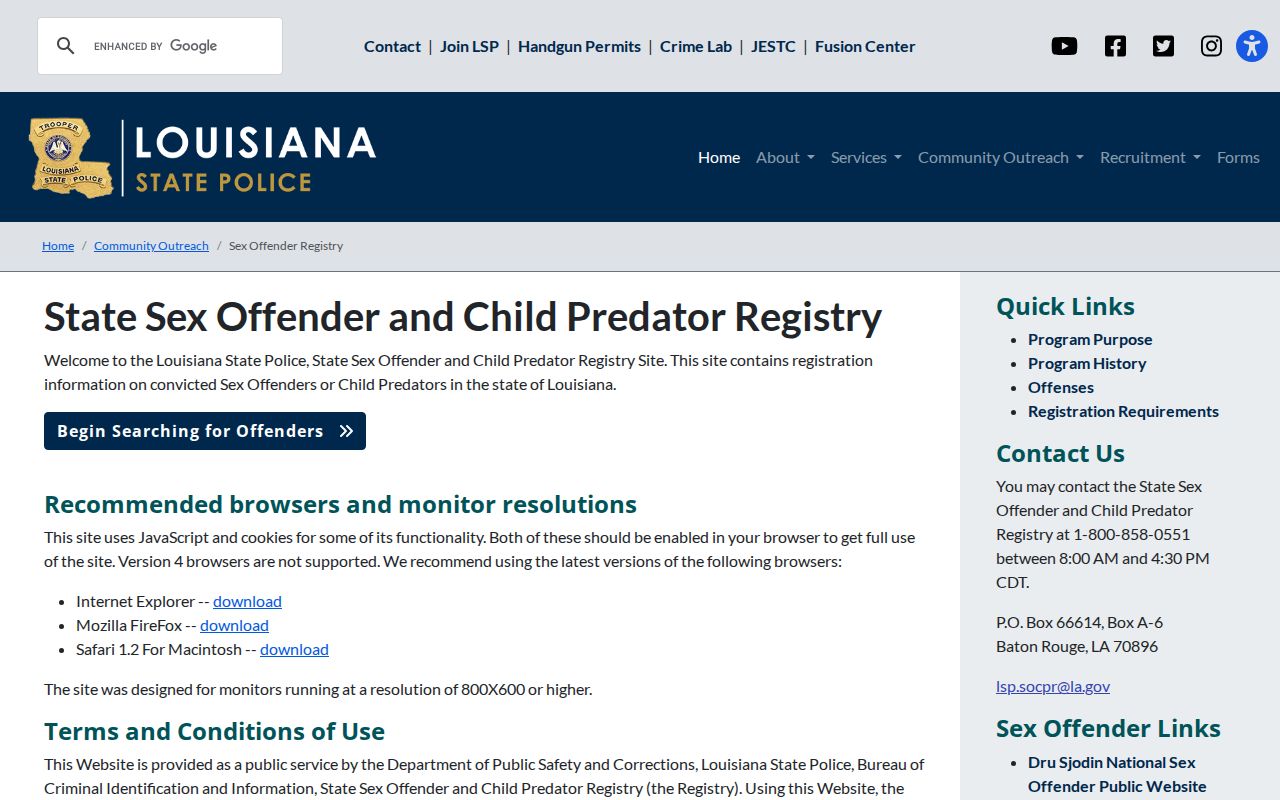
Louisiana tiers are offense categories, not a public risk score. Tier I generally lasts 15 years with annual renewal, Tier II lasts 25 years with semiannual renewal, and Tier III is lifetime with quarterly renewal. Use the dedicated Evangeline Parish sex offender search for the registry fields, tiers, notices, and lawful-use rules.
Evangeline Parish Criminal Records by City
City agencies add another layer. Ville Platte, Mamou, and Pine Prairie police create their own incident records, while parish booking and district prosecution remain separate. Municipal matters may stay in a city court. Each local search should begin with the agency that made the record, then move to EPSO and the 13th Judicial District Court when the event led to parish custody or filed state charges.
Ville Platte Criminal Records
6,303 residents in 2020 · VPPD reports, city matters, and parish routing
Mamou Criminal Records
2,936 residents in 2020 · Police and municipal court counter routes
Pine Prairie Criminal Records
1,490 residents in 2020 · Village records kept apart from federal detention
These Census totals rank the top three incorporated places in the parish. A city address or news dateline does not by itself identify the custodian, so confirm the arresting agency before sending a request. The city guides preserve that distinction and identify local gaps without guessing at unpublished fees, forms, or court contacts.