
Evangeline Parish Federal Criminal Dockets
A federal prosecution arising in Evangeline Parish does not become a 13th Judicial District Court file. Evangeline Parish is served by the Western District of Louisiana's Lafayette Division, and federal docket access runs through PACER. The parish clerk cannot supply those pleadings merely because the event occurred locally.
Official Lafayette Division information confirms the federal venue. PACER requires an account and charges under its published access policy, while courthouse public-access terminals and judicial opinions can be free. Keep that result separate from the Evangeline Parish clerk search.
Evangeline Parish Criminal Court Cases
The 13th Judicial District Court is the general-jurisdiction trial court for Evangeline Parish. Felony prosecutions belong there, and the Evangeline Parish Clerk of Court keeps the filed record. The clerk works from Suite 104 at 200 Court Street in Ville Platte, while the court itself is listed in Suite 200. That distinction matters. A judge conducts the case, but the clerk maintains the index, pleadings, minute entries, rulings, judgment, and copy service.
Lower-level city or municipal matters can remain with the court that heard the citation or ordinance charge. A parish jail booking does not decide which court owns the eventual case. Follow the charging authority: a filed state felony points to the 13th Judicial District Court, while a municipal matter may require the relevant city counter. Evangeline Parish court records should be searched by defendant name or docket number, then checked for the division, charge, and final entry.
Evangeline Parish Cott Search Gate
The Evangeline Parish Clerk of Court website links to a Cott-hosted public-record search. Inspection reached an account login, not a free case-results screen. The gate proves that the clerk offers a linked records system, but it does not prove that criminal coverage, date range, documents, or remote copy access are available to every user. Do not infer a no-record result from an inability to pass that login.
The Evangeline Parish Cott login is useful as the starting point for an existing account holder. Everyone else should use the direct clerk fallback. This official screen shows the account barrier described above.
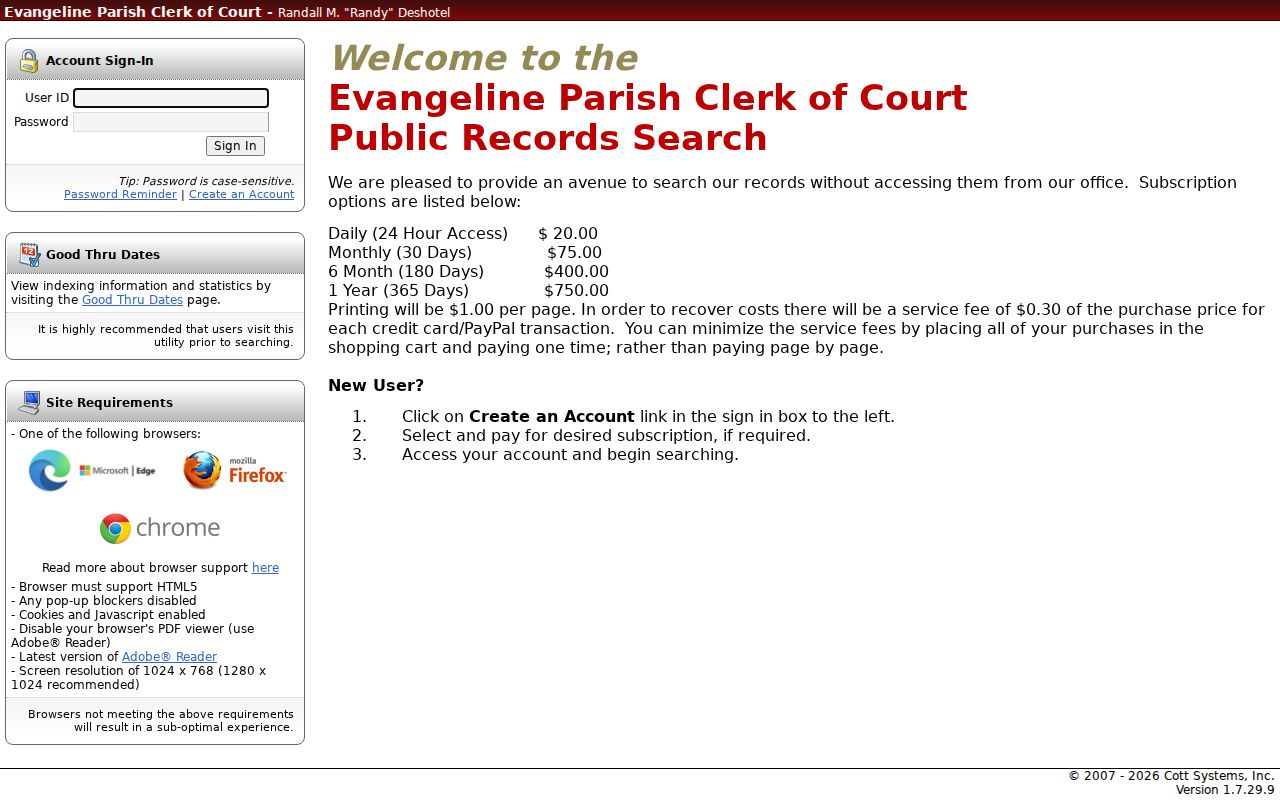
The captured gate helps set expectations: it is not a verified public criminal-case field search and should not replace a call to the clerk.
Searching Evangeline Parish Case Records
Louisiana has no comprehensive, free statewide trial-court case portal. For Evangeline Parish criminal court cases, begin with the clerk and use enough detail to distinguish people with similar names. Ask whether the requested docket is public, whether remote access covers criminal matters, and what the current plain-copy or certified-copy charge will be. The official pages do not publish those criminal fees.
- Check the clerk-linked Cott system if you already have access, but do not assume its criminal coverage.
- Call 337-363-5671 and ask for a defendant-name or docket-number search in the criminal records.
- Give a useful date range, spelling variants, and the case number when known.
- Ask for the charging instrument, docket or minute entries, disposition, judgment, and sentence needed for your purpose.
- Confirm the current copy fee and request a certified copy when proof of the filed outcome is required.
Because no open criminal search form was verified, the table is a clerk request checklist, not a claimed portal schema.
| Search detail | Type | Required | Use |
|---|---|---|---|
| Defendant name | Text | Usually | Include full spelling and aliases if known |
| Docket number | Text | No | Best match when available |
| Filing date range | Date range | No | Narrows common-name results |
| Division or judge | Text | No | Confirms the correct proceeding |
| Charge or statute | Text | No | Helps separate similar cases |
Evangeline Parish Clerk Fallback
When remote access falls short, contact the clerk by counter, mail, phone, or fax. The official Evangeline Parish clerk contact page lists the counter at 200 Court Street, Suite 104, Ville Platte, Louisiana 70586; mailing address P.O. Box 347; phone 337-363-5671; fax 337-363-5780; and weekday hours of 8:00 a.m. to 4:30 p.m. Ask before sending payment because criminal search, page, and certification fees are not posted.
The official contact screen gives the dependable routes for Evangeline Parish case records. It is especially useful when a Cott account is unavailable or a docket needs a certified disposition.
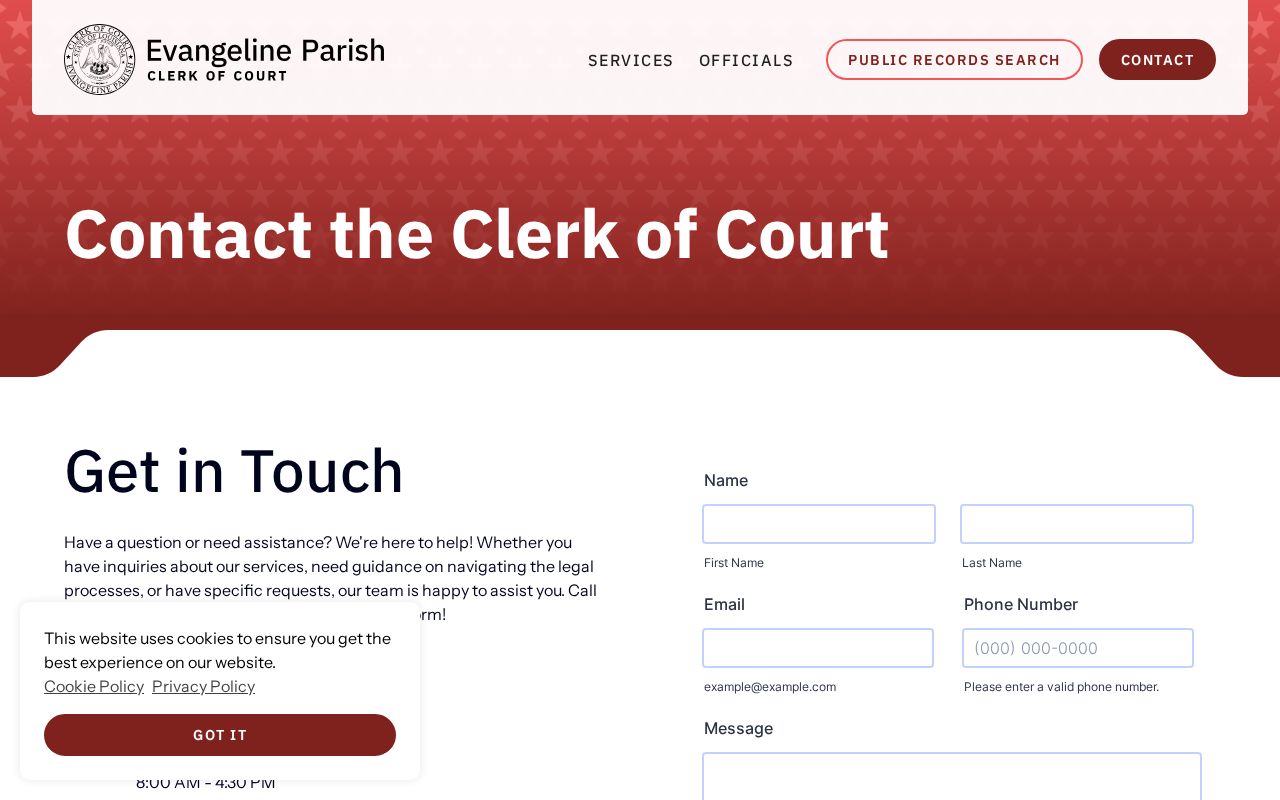
The clerk can also clarify whether a requested file is held in district court or belongs to a city-level court.
Evangeline Parish Clerk of Court
200 Court Street, Suite 104
Ville Platte, LA 70586
P.O. Box 347
337-363-5671
Fax: 337-363-5780
Monday-Friday, 8:00-4:30
Note: Give the clerk a narrow request and ask for certification before relying on a scan or docket summary as formal proof.
Inside an Evangeline Parish Case File
An Evangeline Parish criminal case file is a set of court documents, not a single summary. The charging instrument shows what prosecutors filed. Minute entries track appearances, pleas, and rulings. Motions and orders explain litigation steps. The judgment and sentence reveal the adjudicated outcome. Probation or revocation entries may arrive later, and warrant or capias entries can appear on the docket when the court issues process.
| Docket number and court | Identifies the proceeding, division, and court that owns the file. |
|---|---|
| Charging instrument | Shows charges formally filed, which may differ from booking allegations. |
| Minute and docket entries | Chronicle arraignment, pleas, hearings, motions, rulings, and appearances. |
| Disposition and judgment | Records dismissal, acquittal, plea, or other final adjudication when entered. |
| Sentence and conditions | Shows custody, probation, financial terms, and later revocation activity when filed. |
| Warrant or capias entries | May identify court process, though sealed or restricted material may not be public. |
The clerk file can contain documents that never appear in a BCII rap sheet. That is why Evangeline Parish court records are the primary source for the exact filed charge and judgment.
Evangeline Parish Charges Can Diverge
A booking charge, filed charge, and repository entry answer different questions. The arresting agency records its basis for the arrest. The district attorney then chooses whether and what to file. The Evangeline Parish clerk records the prosecution and its outcome. BCII later links reported arrest and disposition data to an identity-based criminal-history cycle. Each record may update at a different time.
A minute entry is also not the same as a judgment. A minute may note what happened in court that day, while a signed judgment states the formal result. A rap sheet compresses reported events into coded history rather than reproducing the pleadings. If the public booking and the clerk docket disagree, use the filed papers and final judgment to understand the prosecution. For more context on the first custody record, the Evangeline Parish arrest lookup explains the booking side of that trail.
- Arraignment
- The hearing where the accused is called on to enter a plea to filed charges.
- Minute entry
- The clerk's concise record of activity during a court session.
- Disposition
- The way a charge ended, such as dismissal, acquittal, or conviction.
- Capias
- Court process directing that a person be taken into custody.
How an Evangeline Parish Case Moves
An Evangeline Parish prosecution starts as a separate file only when charges are filed. Arraignment follows so the charge and plea enter the docket. Pretrial work can include motions, discovery issues, scheduling, and rulings. A plea may resolve the case, or a trial may produce a verdict. The clerk then records the disposition and judgment, followed by sentencing when applicable.
Case flow: Charges Filed › Arraignment › Pretrial › Plea or Trial › Disposition › Sentencing
This flow also shows why a fresh jail entry can have no court match yet. Filing is a later act. Likewise, a court result may take time to reach the state repository. Search Evangeline Parish records at the stage that can answer the question, then verify later stages before drawing a conclusion.
Evangeline Parish Reports Are Separate
The Evangeline Parish Sheriff's Office Records Division processes sheriff arrest and summons reports and prepares reports for the district attorney's charging review. That work supports a later court case, but the report remains an agency record. The EPSO Records page lists weekday hours of 8:00 a.m. to 4:00 p.m. and a $5 to $10 range for certain reports. It does not make the sheriff the custodian of the district-court file.
The official page illustrates the Records Division's role in the Evangeline Parish record chain.
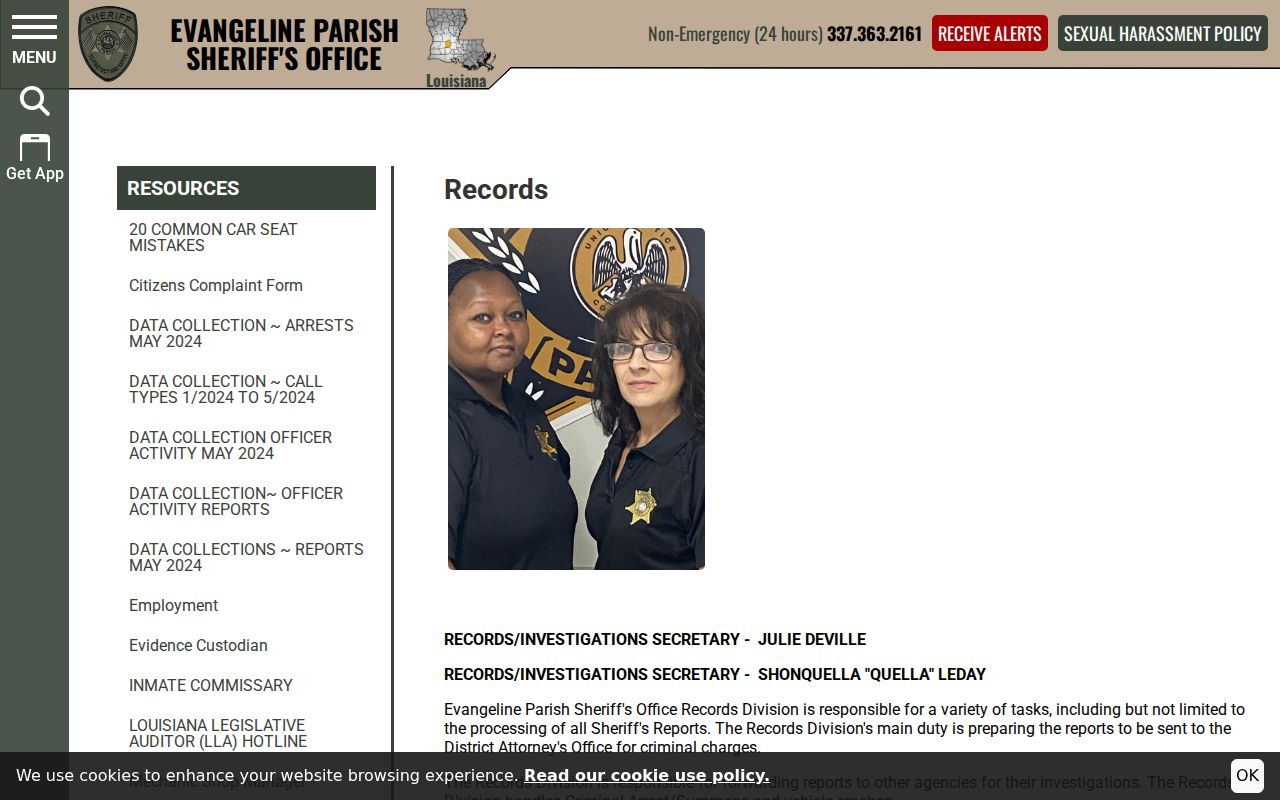
Ask the sheriff for its report and the clerk for pleadings, minutes, judgment, and sentence. That division of custody prevents a partial agency file from being mistaken for the whole case.
Case Record Access & Restrictions
Louisiana Public Records Law broadly defines public records, but it does not make every criminal record open. Court files follow court-access rules. Agency intelligence, investigative material, juvenile information, victim data, security material, and pending enforcement information can fall under statutory restrictions. A public clerk index can also be narrower than the paper file, and a redacted view does not prove that no additional sealed material exists.
Expungement changes public access without destroying all records. Louisiana Code of Criminal Procedure Articles 971 through 973 make covered records confidential while preserving access for listed criminal-justice and statutory purposes. When an Evangeline Parish case cannot be found, ask the clerk whether the problem is spelling, date range, court level, remote coverage, or a restriction. Do not ask the clerk to reveal a sealed file to an unauthorized requester.
Note: A missing online result is not proof that no Evangeline Parish case exists or that a prior record was destroyed.