
Checking Criminal History in Pine Prairie
Start by deciding whether the matter involves Pine Prairie Police, EPSO, a court, or federal immigration custody. Village police reports stay with the creating department. Ordinary local booking is checked through the parish. Felony prosecutions go to the 13th Judicial District Court. A subject seeking their own Louisiana criminal-history record uses State Police BCII's fingerprint-based Right to Review.
- Identify the investigating agency and separate village law enforcement from federal immigration operations.
- Call Pine Prairie Police and ask for the custodian and method for a precise report request.
- Verify any village-court channel directly because no official public case portal was located.
- Check the parish roster and clerk for booking, filed charges, disposition, and sentence.
- Use the fingerprint-based state process when the subject needs an identity-confirmed Louisiana history.
A negative answer from one channel does not cover the others. Record the event date, location, report or booking number, name variants, and agency at each step. Never treat an allegation at booking as a final finding.
Pine Prairie Police Records Start Locally
The official Louisiana DCFS directory lists Pine Prairie Police at 1006 Edwin Elliott Drive, Pine Prairie, LA 70576, with 337-599-2708 and emergency 911. A 2024 department release instead gave 337-599-2904 and parish dispatch at 337-363-2161. Because the two official-source numbers differ, callers should verify which nonemergency number is current.
No official standalone records page, records email, public hours, form, arrest blotter, search portal, or app was found. When contact is made, ask who serves as records custodian, whether a written request is required, what details help locate the record, and whether inspection or copies are offered. Do not invent a village form or assume that an unanswered line proves no record exists.
Pine Prairie Police Department Records
Pine Prairie Police creates reports for village events it handles. Those records may include an incident narrative, arrest or summons material, and related evidence, subject to Louisiana access restrictions. A police report is not a jail booking, court judgment, or statewide rap sheet. Each record must be obtained from its own custodian.
The official state directory listing for Pine Prairie Police is the verified contact source. The successful manifest image documents that official route.
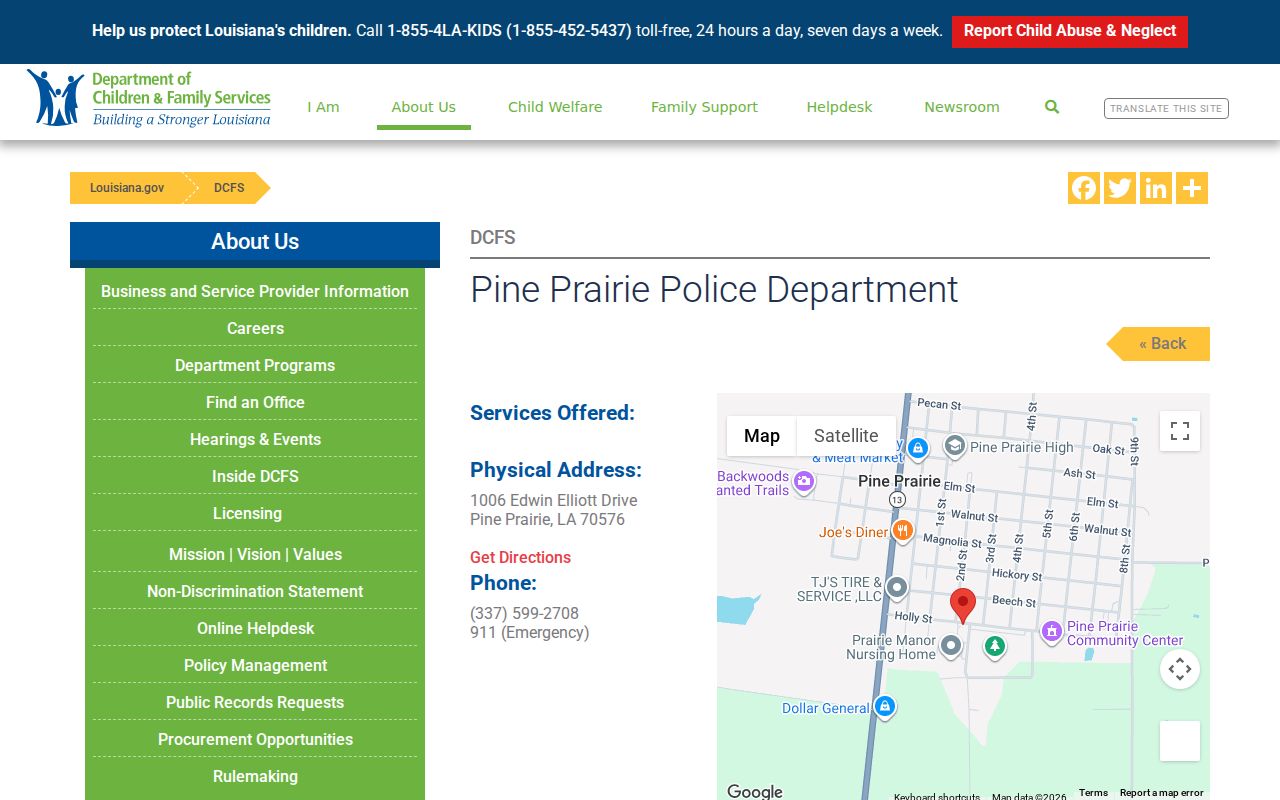
Use the listing to start contact, then confirm the current number and request method. For emergency service use 911. Parish dispatch can help identify the responding agency, but it should not be described as a promised records-delivery channel.
If the department directs a requester to a village office, verify its name, address, and submission instructions during the call. The research did not establish a village hall or court counter, so an unofficial directory should not fill that gap. Note who gave the routing information and what type of record the office agreed to search.
Pine Prairie ICE Is Not Village Jail
The Pine Prairie ICE Processing Center at 1133 Hampton Dupre Road is a federal immigration-detention facility. It is not the Pine Prairie municipal jail and is not the ordinary destination for a village arrest. A search for a Pine Prairie inmate can therefore lead into the wrong legal and records system.
First distinguish criminal custody from civil immigration detention. An ordinary village arrest should be traced through parish booking unless a source identifies another facility. A federal immigration custody question follows federal channels. The facility's group-quarters population can also affect how place population is interpreted, so it should not be mixed casually into village crime rates.
Pine Prairie Arrests and Bookings
The supported local chain is Pine Prairie Police report followed by Evangeline Parish booking, then a district-court file if the prosecutor files charges. The sheriff's current and released inmate roster is the official public booking search found for the parish. It does not replace the village report or prove the final court result.
A booking entry can appear before a court case and may list charges that later change. If current custody is the issue, use the parish arrest lookup. If filed charges, minutes, disposition, or sentence are the issue, contact the clerk. The absence of a person from a current roster is not a complete Pine Prairie criminal-history check.
Three Pine Prairie Record Trails
Pine Prairie Police, EPSO, and federal ICE operations can all appear in reporting tied to the village. They do not maintain one combined public file. A January 2025 EPSO release about alleged narcotics possession by a correctional officer at the ICE facility described Pine Prairie Police cooperation, illustrating how a single event can create records at more than one agency.
Ask which agency generated the incident report, which agency made the arrest, where booking occurred, and whether the matter is criminal or immigration-related. Then request each product from the relevant custodian. A multi-agency response does not grant every participating office custody of every report.
Municipal Court Records in Pine Prairie
No official Pine Prairie mayor's court or municipal court portal and no verified current contact page were found. The research therefore does not support naming a judge, schedule, fee, clerk, or court address. Felony prosecutions go to the 13th Judicial District Court, whose records are held by the Evangeline Parish Clerk of Court.
| Court Name | Village or mayor's court channel must be verified locally; 13th Judicial District Court handles felonies |
|---|---|
| Case Types Heard | Local matters only if within verified village-court authority; state felony cases belong in district court |
| Case Lookup Channel | No official village case portal located; verify the counter with the village |
| What the Docket Shows | No official public field inventory found |
| Copies & Fees | Not published; ask the verified custodian before ordering |
This gap should remain visible rather than being filled with an unofficial directory. If the village confirms that a matter does not belong locally, check the district clerk for state charges.
Security Video and Same-Day Recovery
An October 2024 Pine Prairie Police release described local security footage used in the same-day recovery of a stolen golf cart. It also routed suspicious-activity calls through parish dispatch. The episode illustrates village and parish coordination, but a news release is not a complete arrest log or substitute for the underlying report.
A person seeking records from such an event should identify who created the report and ask separately about releasable video. Active investigations, evidentiary concerns, victim information, and security content may affect access. Dispatch involvement does not automatically make EPSO the custodian of Pine Prairie Police material.
Where Pine Prairie Records Go
Pine Prairie Police creates the local report. Parish booking produces the custody entry. A filed state prosecution creates a court file, and fingerprintable arrest data and later dispositions may reach BCII. These systems can update at different times and contain different charge descriptions.
Record flow: Pine Prairie Police Department › Evangeline Parish Courts › Louisiana State Police Bureau of Criminal Identification and Information
Not every event reaches every stage. A citation might not produce booking. A prosecutor may decline charges. A court charge can differ from the initial allegation. The parish criminal court cases channel is the source for filed pleadings, minutes, judgment, and sentence, while one's state record is checked through fingerprint review.
Act 187 Changed Chief Qualifications
Louisiana HB50 became Act 187 in June 2024 and changed qualifications for the Pine Prairie police chief. The official bill history documents that local governance change. It is relevant context for the department, but it does not create a criminal-record portal or alter which custodian holds a particular report.
The successful manifest capture preserves the official legislative source for this Pine Prairie milestone.
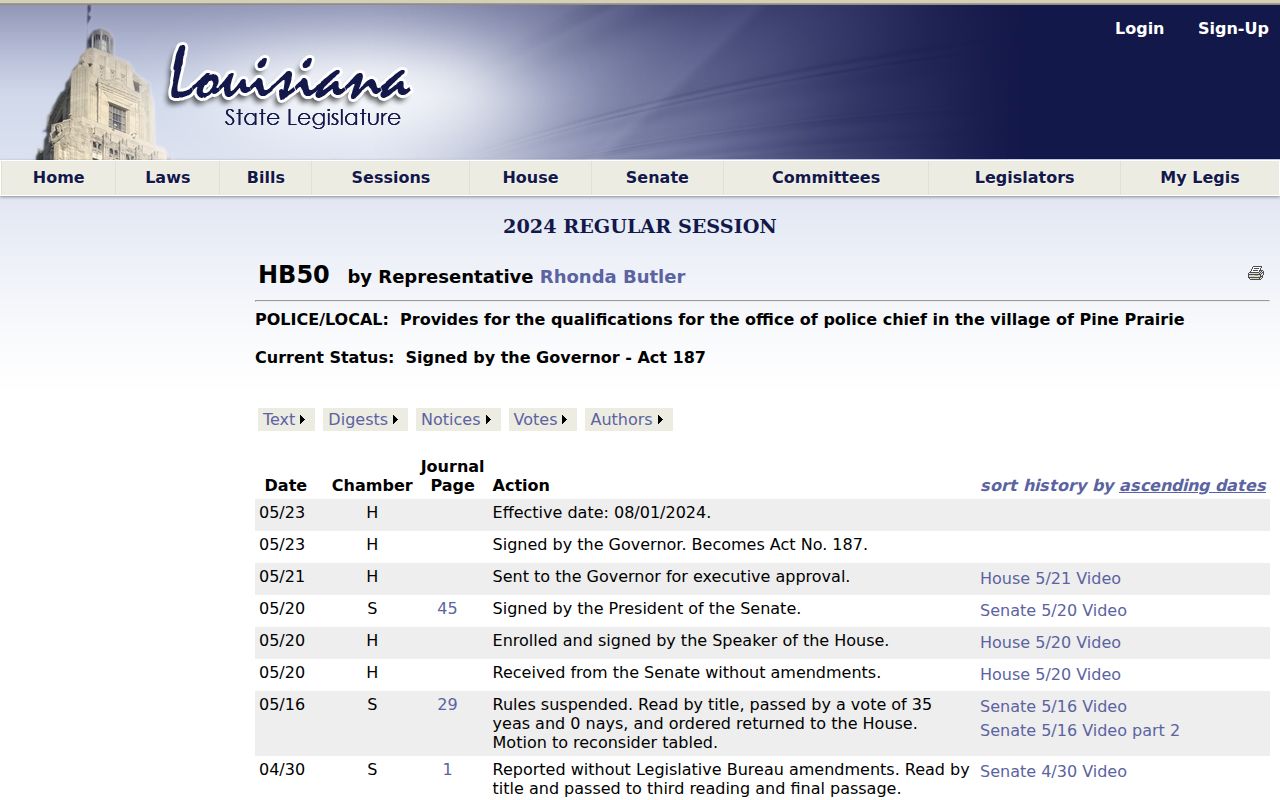
Record seekers should still verify the current department contact and custodian. Governance news and public-record access are related only when an official source states that a procedure changed.
Checking Pine Prairie Police Data
Pine Prairie publishes no complete annual crime table. FBI Crime Data Explorer figures should be quoted only after checking Pine Prairie Police coverage by agency, year, reported months, population basis, and whether the measure is arrests or offenses. Missing months and no-data displays do not equal zero crime.
Do not mix EPSO incidents or ICE-facility events into a village total. The agencies report separately, and the federal detention site changes the meaning of some location-based searches. Crime statistics describe reported aggregates; they cannot answer whether an individual has a police report or court record.
Write a Pine Prairie Records Request
With no verified village form, use a concise request that names the sought record and event. Include the date, time, location, person name, report or citation number if known, and whether inspection or a copy is preferred. Ask the custodian to identify fees, accepted payment, delivery methods, and any required proof of identity or authorization.
Record the responding office, contact date, and any report number it supplies. Those details help later custodians match the village report, parish booking entry, and filed charge even when their terms differ. This is especially useful in Pine Prairie, where a place name can point to village police, parish deputies, state officers, or the separate federal detention facility.
Follow document custody instead of relying on location alone. The agency report explains the investigation, the EPSO entry documents parish booking, and the clerk file shows prosecution. A record absent from one of those systems may still exist in another because each office creates and updates its own product.
If the response indicates EPSO handled the event, redirect the request to sheriff Records. If the question concerns a filed prosecution, ask the parish clerk. If it concerns ICE detention, move to the appropriate federal channel. Keeping the request narrow helps prevent a village event and a federal facility matter from being blended under the same place name.
For photographs, video, dispatch audio, or evidence, describe the exact item and ask which agency created it. The presence of security footage in a public release does not mean the footage itself is posted or automatically open. Investigative needs, victim information, juveniles, and security content can affect release.
If no village report is located, verify the event address, date, responding unit, and incident number through parish dispatch. Then check whether EPSO or another agency led the response. A no-record answer from Pine Prairie Police does not resolve a parish case, and parish booking does not identify who holds the investigative narrative.
Public Access Rules in Pine Prairie
Louisiana's public-records definition covers many records used or held in public business, including electronic material, but legal exceptions remain. The village police custodian can redact or withhold protected investigative, juvenile, victim, intelligence, or security information when the law applies. Court files and statewide criminal histories follow their own channels.
Key Statutes:
Louisiana Public Records Law, R.S. 44:1 - Defines public records and custodians, subject to constitutional and statutory exceptions.
Louisiana Code of Criminal Procedure Article 971 - Explains that expungement removes eligible records from public access without destroying them.
Louisiana R.S. 44:36 - Provides general retention rules without guaranteeing public disclosure of every retained item.
BCII dissemination is more limited. IBC is account based and intended for authorized purposes, not unrestricted personal searching. A person reviewing their own statewide history should use the fingerprint-based Right to Review and compare any disputed entry with the Pine Prairie report and relevant court papers.